

Automotive Engine Encapsulation Market Growth Projected to Reach USD 10.16 Billion, at 5.74% CAGR By 2026 To 2035
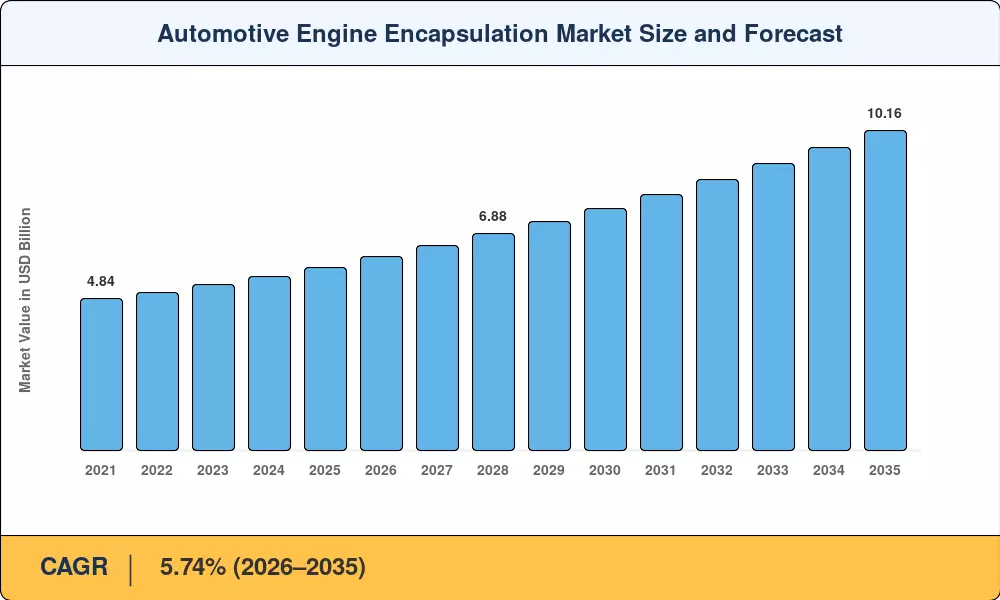
Automotive Engine Encapsulation Market Summary
Carbon fiber composites captured 36.6% of the Automotive Engine Encapsulation Market share in 2025, supported by declining precursor costs.
North America represented approximately 22.0% of global revenue, propelled by pickup truck and SUV thermal management upgrades.”
NY, CA, UNITED STATES, July 3, 2026 /EINPresswire.com/ -- The Automotive Engine Encapsulation Market was valued at USD 5.82 Billion in 2025 and is projected to reach USD 6.15 Billion in 2026 before climbing to USD 10.16 Billion by 2035, registering a CAGR of 5.74% during 2026–2035.— Arti Dhapte
Automotive Engine Encapsulation Market Overview
Automotive engine encapsulation market trends refers to the strategic application of thermal and acoustic insulation materials around the engine compartment and underbody areas of a vehicle. These systems, typically composed of multi-layer composite assemblies, serve multiple critical functions: retaining heat to reduce cold-start emissions, attenuating powertrain noise for improved cabin comfort, and providing thermal protection for adjacent components and cabin surfaces. Encapsulation solutions range from engine-mounted covers and body-mounted shields to sophisticated underbody aerodynamic-thermal panels that integrate structural and acoustic functions into a single component.
The market is experiencing robust growth driven by the convergence of tightening emissions regulations and the accelerating electrification of global vehicle fleets. Tightening Euro 7 cold-start emissions limits and California's Advanced Clean Cars II mandate are compelling automakers to treat under-hood thermal retention as a compliance necessity rather than a premium add-on . That regulatory tailwind, combined with OEM commitments exceeding USD 515 billion to electrification programs globally through 2030, is reshaping how powertrains are packaged and insulated . Engine encapsulation directly addresses regulatory requirements by retaining under-hood heat for up to four hours post-shutdown, cutting cold-start hydrocarbon emissions by an estimated 15–25%.
Industry trends indicate a fundamental shift from legacy single-layer fiberglass covers to multi-functional composite assemblies that simultaneously manage heat retention, cabin noise attenuation, and aerodynamic drag. Digital-twin simulation loops now allow engineers to merge structural, thermal, and acoustic functions into fewer components, reducing part counts by 15–20% on new-generation platforms. Gigacasting adoption by leading EV manufacturers has further accelerated the integration of encapsulation elements into underbody mega-castings, consolidating thermal-management functions into higher-value cast assemblies.
Technological developments are reshaping the encapsulation landscape at an accelerated pace. Generative AI design tools are projected to cut encapsulation development cycles from 18 months to under six months by 2030, enabling multi-objective optimization across thermal retention, weight, recyclability, and crash performance . Carbon fiber composites, which captured 36.6% of the market share in 2025, are benefiting from declining precursor costs, making them viable for mid-volume production runs beyond the luxury tier . BASF's introduction of Ultramid Advanced T1000 polyamide, withstanding continuous temperatures up to 230°C, exemplifies the development of advanced engineering plastics specifically for under-hood applications.
📍 Get Free Sample Report for Detailed Market Insights:
https://www.marketresearchfuture.com/sample_request/6148
Automotive Engine Encapsulation Market Segmentation
By Product Type
The automotive engine encapsulation market is segmented by product type into Engine-Mounted and Body-Mounted systems. Engine-mounted encapsulation systems accounted for approximately 54.7% of the market in 2025, reflecting their critical role in cold-start thermal management and emissions compliance . These systems typically combine a rigid outer shell with an inner acoustic absorber layer, retaining engine-bay temperatures 30–40°C above ambient for up to four hours after shutdown. Body-mounted designs are projected to grow at a 7.84% CAGR through 2035 as lightweight platforms integrate encapsulation into structural body panels, particularly on EV and hybrid platforms where underbody panels double as aerodynamic fairings and thermal barriers.
By Fuel Type
Fuel type segmentation includes Gasoline, Diesel, and Electric/Hybrid powertrains. Gasoline engines represent the broadest installed base with approximately 60.6% market share, though their share will erode as electrification scales . Diesel powertrains, while declining in passenger cars, maintain relevance in heavy commercial vehicles with a 4.82% CAGR through 2035. Electric and hybrid encapsulation is the fastest-growing segment at 8.14% CAGR, commanding a premium on per-unit content value because dual-zone thermal management—simultaneously insulating battery packs and power electronics—requires advanced multi-material composites .
By Material Type
Material type segmentation covers Carbon Fiber, Polyurethane, Polypropylene, and Others. Carbon fiber composites hold the largest share with 36.6% in 2025, driven by exceptional thermal resistance and a superior strength-to-weight ratio . Polyurethane represents the second-largest segment, valued at USD 1.14 billion in 2025, prized for its acoustic absorption performance. Polypropylene is the fastest-growing material at 7.16% CAGR, benefiting from circular-economy mandates that favor mono-material recyclability . The "Others" category includes glass wool, advanced composites, and novel bio-based materials emerging in response to sustainability requirements.
By Vehicle Type
Vehicle type segmentation divides the market into Passenger Cars, Light Commercial Vehicles, and Heavy Commercial Vehicles. Passenger cars account for approximately 62.0% of the market share, driven by high-volume global production and rising NVH expectations across all price segments . Light commercial vehicles are growing at a 6.21% CAGR through 2035, fueled by last-mile fleet electrification and urban delivery vehicle upgrades. Heavy commercial vehicles represent a specialized segment valued at USD 0.42 billion in 2025, with long-haul diesel applications requiring robust thermal retention systems to maintain operational efficiency in demanding conditions.
By Sales Channel
Sales channel segmentation includes OEM-Fitted and Aftermarket. OEM-fitted systems dominate with approximately 80.5% market share, as encapsulation geometry must be co-designed with the engine bay or underbody structure during the vehicle's development phase . The aftermarket segment is the fastest-growing channel at 7.40% CAGR, driven by urban low-emission-zone compliance retrofit demand. Tightening low-emission-zone rules in over 320 European cities create retrofit demand for thermal encapsulation kits on older commercial vehicles seeking extended zone access permits.
🛒 You can buy this market report at:
https://www.marketresearchfuture.com/checkout?currency=one_user-USD&report_id=6148
Automotive Engine Encapsulation Market Regional Analysis
North America
North America represents approximately 22.0% of global market revenue, propelled by pickup truck and SUV thermal management upgrades and EPA compliance requirements . The United States dominates regional demand because pickup trucks and large SUVs—which carry higher encapsulation content per vehicle—represent over 60% of domestic light-vehicle sales. The Inflation Reduction Act's domestic-content provisions incentivize local sourcing of encapsulation components for qualifying EV platforms, reinforcing nearshoring trends among Tier-1 suppliers. Canada contributes through cold-climate thermal retention requirements, while Mexico's export-oriented assembly hub expansion supports regional growth.
Europe
Europe held the second-largest share at roughly 18.5% of the global market, where premium German OEMs set the pace on NVH standards and Euro 7 compliance drives innovation. Germany's role as the engineering heartland stems from the exacting NVH specifications set by BMW, Mercedes-Benz, and the Volkswagen Group, whose platforms define encapsulation performance benchmarks adopted industry-wide. The United Kingdom shows a 5.62% CAGR through post-Brexit localization incentives. France and Italy contribute through Renault-Stellantis platform consolidation and luxury vehicle thermal tuning respectively. Eastern European countries are emerging as manufacturing hubs, benefiting from lower production costs and proximity to Western European assembly plants.
Asia-Pacific
Asia-Pacific dominated the market with an estimated 51.5% share in 2025 and leads the growth trajectory at 8.75% CAGR . China is the dominant force, with its 28-million-unit annual vehicle output and aggressive new-energy vehicle production targets. BYD, Geely, and NIO are specifying multi-layer encapsulation on new-energy platforms at rates comparable to German luxury OEMs, rapidly closing the NVH gap between Chinese and European brands . India shows an 8.92% CAGR, supported by the Production-Linked Incentive scheme for auto components and Bharat NCAP noise standards. Japan and South Korea contribute through Toyota/Honda hybrid platform depth and Hyundai-Kia E-GMP thermal architecture respectively. ASEAN markets, led by the Thailand-Indonesia assembly corridor, present a 7.64% CAGR opportunity.
South America
South America presents a developing market with a 4.55% CAGR through 2035. Brazil anchors the region with 68.3% of regional share, driven by its Rota 2030 automotive industrial policy program that requires progressive improvements in energy efficiency, indirectly boosting demand for thermal encapsulation on flex-fuel and hybrid platforms . Argentina contributes through light-commercial assembly growth, while the rest of the region remains dependent on CKD import markets.
Middle East & Africa
The Middle East & Africa region, valued at USD 0.20 billion in 2025, shows nascent growth potential. Saudi Arabia's Vision 2030 automotive assembly investments, including the Ceer and Lucid Motors joint ventures, generate nascent demand for locally sourced encapsulation components . The UAE contributes through luxury vehicle import volumes, while South Africa serves as a regional export hub for European OEMs. Egypt and other markets show gradual CKD assembly expansion and nascent local-content programs.
Competitive Landscape / Key Players
The automotive engine encapsulation market exhibits medium concentration, with the top five players holding an estimated 38–45% combined revenue share . Key companies operating in this market include Röchling Automotive, Autoneum Holding AG, Continental AG, ElringKlinger AG, Carcoustics International, Adler Pelzer Group, BASF SE, Lydall (Unifrax), Henkel AG, and Tenneco Inc.
Röchling Automotive, with an estimated 8–11% revenue share, leads the market with multi-layer engine covers and aerodynamic underbody shields, serving as a European Tier-1 with deep OEM co-development ties . Autoneum Holding AG follows with 7–10% share, specializing in acoustic and thermal management components, and recently expanded into EV thermal barriers with its Ultra-Silent Frunk architecture . Continental AG holds 5–8% share, offering integrated powertrain encapsulation modules that leverage the company's electronics synergy. ElringKlinger AG has pivoted from gaskets to holistic thermal solutions with 4–7% share.
Strategic developments include consolidation of global manufacturing footprints, as demonstrated by Röchling Automotive's April 2025 announcement to close its Chengdu, China, plant to optimize capacity utilization . Material innovation remains a competitive differentiator, with suppliers investing in mono-material thermoplastic encapsulation to meet EU recycling mandates . Vertical integration and partnerships with OEMs during the digital-twin development phase provide competitive advantages, as early co-development gives incumbents a significant edge in program nominations.
To explore more market insights, visit us at:
https://www.marketresearchfuture.com/reports/automotive-engine-encapsulation-market-6148
Latest Industry News & Developments
In a significant product development, Autoneum announced in February 2026 the commercial launch of its innovative Ultra-Silent Frunk architecture, expanding its lightweight acoustic and thermal polymer insulation portfolio to enhance high-volume battery-electric vehicle programs . This development reflects the industry's pivot toward EV-specific encapsulation solutions.
BASF SE introduced Ultramid Advanced T1000 polyamide in April 2024, specifically designed for under-hood encapsulation applications withstanding continuous temperatures up to 230°C . This material innovation addresses the thermal management challenges of modern high-output powertrains and turbocharged engines.
The European Commission published final Euro 7 implementing regulations in November 2026, specifying cold-start thermal retention test protocols that directly reference engine encapsulation performance . This regulatory milestone establishes clear compliance benchmarks that will drive encapsulation adoption across the European market through the forecast period.
Röchling Automotive announced in April 2025 the consolidation of its global manufacturing footprint, finalizing the closure of its production plant in Chengdu, China, to optimize capacity utilization across its remaining regional facilities . This strategic move reflects the industry's focus on operational efficiency and supply chain optimization.
More Related Reports from MRFR Library:
https://www.marketresearchfuture.com/reports/automotive-ultracapacitor-market-25144
https://www.marketresearchfuture.com/reports/district-heating-market-19255
https://www.marketresearchfuture.com/reports/india-electric-car-market-12684
https://www.marketresearchfuture.com/reports/automotive-fuel-delivery-system-market-2193
https://www.marketresearchfuture.com/reports/control-valve-market-1940
https://www.marketresearchfuture.com/reports/automotive-fasteners-market-6399
https://www.marketresearchfuture.com/reports/commercial-vehicle-market-34525
https://www.marketresearchfuture.com/reports/automotive-ethernet-market-21944
https://www.marketresearchfuture.com/reports/clean-coal-technology-market-10012
https://www.marketresearchfuture.com/reports/forestry-equipment-market-26097
Larry Wilson
WantStats Research And Media Pvt. Ltd.
+1 855-661-4441
email us here
Visit us on social media:
LinkedIn
Facebook
YouTube
X
Legal Disclaimer:
EIN Presswire provides this news content "as is" without warranty of any kind. We do not accept any responsibility or liability for the accuracy, content, images, videos, licenses, completeness, legality, or reliability of the information contained in this article. If you have any complaints or copyright issues related to this article, kindly contact the author above.
