

Automotive Collision Repair Market to Reach USD 319.58 Billion by 2035 at 3.52% CAGR
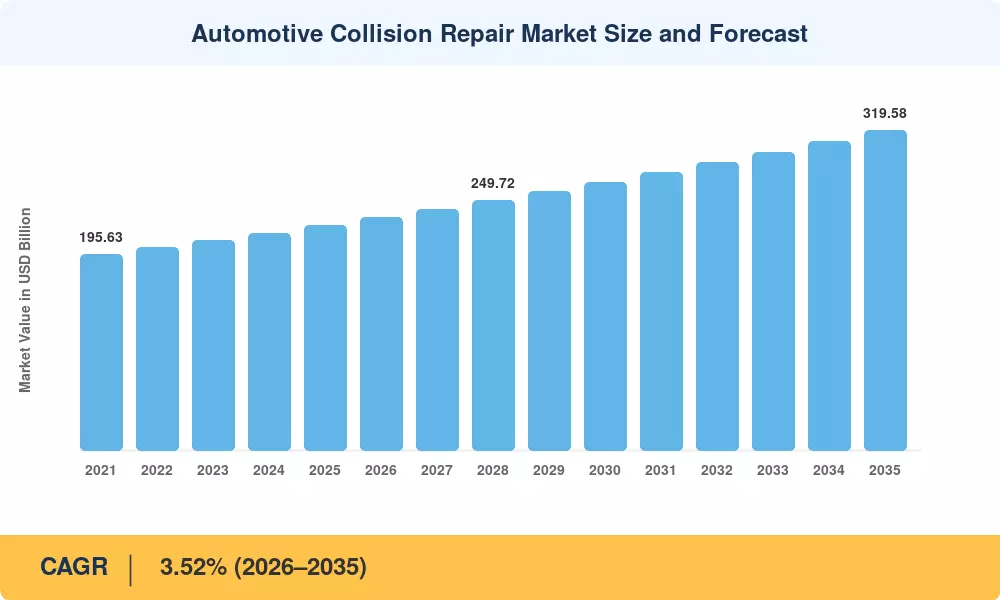
Automotive Collision Repair Market
The Automotive Collision Repair Market was valued at USD 224.67 billion in 2025 and is projected to reach USD 231.58 billion in 2026.
The Automotive Collision Repair Market was valued at USD 224.67 billion in 2025 and is projected to reach USD 231.58 billion in 2026 before climbing to USD 319.58 billion by 2035.”
NEW YORK, NY, UNITED STATES, July 21, 2026 /EINPresswire.com/ -- Automotive collision repair encompasses the full spectrum of services required to restore a vehicle to its pre-accident condition following damage from a crash, impact, or environmental event . This includes structural straightening, body panel replacement, paint refinishing, mechanical repairs, and increasingly, the recalibration of advanced driver-assistance systems (ADAS) . The repair process is comprehensive, often involving initial damage assessment through computerized estimating systems, structural repair using specialized equipment, cosmetic refinishing, mechanical repairs, and finally, system calibration and quality control checks . Collision repair services are delivered through a diverse ecosystem of independently owned body shops, franchise networks, and OEM-certified collision centers, each with varying capabilities.— Arti Dhapte
The market's steady growth trajectory is driven by two powerful catalysts: the average age of vehicles on U.S. roads has crossed 12.6 years according to MRFR data, pushing repair frequency higher, and the European Commission's General Safety Regulation mandates ADAS recalibration post-collision for every new vehicle sold after July 2024 . These policy and demographic tailwinds guarantee a steady pipeline of complex repair jobs across every major geography.
Industry trends indicate a decisive shift toward technology-intensive and specialized repair environments. Legacy panel-beating and spray-booth workflows are giving way to sensor-rich repair environments . Frame straightening collision repair now routinely integrates 3D measuring systems, while OEM certified collision repair programs require shops to invest USD 150,000–400,000 in tooling and training per brand certification . Battery-safe structural procedures for electric vehicles add another layer of complexity, and paintless dent removal (PDR) is gaining share for aluminum body repair operations where heat-based methods risk compromising lightweight substrates.
Technological developments are reshaping the repair process and market structure. Digital estimation platforms using AI and photo-based damage assessment can now estimate collision damage with accuracy exceeding 85%, compressing the estimate-to-repair cycle from five days to under 48 hours . The integration of 3D measuring systems and computerized frame straightening equipment enables precise structural repairs . Advanced refinish systems, including AI-powered color-matching technology, reduce refinish attempts by 30%, cutting cycle time for repair workflows . Emerging technologies such as digital twin simulations are being explored to improve repair planning and minimize errors.
Policy and regulatory influence on the market is substantial and growing. The European Commission's General Safety Regulation Phase II (July 2024) mandates ADAS recalibration post-collision documentation for all insurance-covered repairs on vehicles built after 2024, expanding the addressable market . Stringent VOC emissions regulations under EU Directive 2004/42/EC and California's SCAQMD Rule 1151 are driving adoption of waterborne paint systems . The EU's End-of-Life Vehicles Regulation revision (2023) tightens recyclability targets, favoring shops equipped for PDR and sustainable waste handling . OEMs themselves are increasingly controlling certification programs to ensure repair quality that maintains vehicle safety and performance.
The demand outlook remains positive, supported by an aging global vehicle fleet, rising vehicle complexity, and growing vehicle parc in emerging economies. Europe commanded roughly 35.08% of global revenue in 2024, driven by stringent MOT testing regimes and high labor rates . Asia-Pacific stands as the fastest-growing region with a projected CAGR of 8.29%, fueled by surging vehicle parc growth in India, China, and ASEAN nations . North America follows as the second-largest region, accounting for an estimated USD 62.41 billion in 2025 revenue.
📍 Get Free Sample Report for Detailed Market Insights:
https://www.marketresearchfuture.com/sample_request/22147
Market Segmentation
By Damage Type
The market is segmented by damage type into Cosmetic and Paint, Structural Repair, and Glass and ADAS Calibration . Cosmetic and paint jobs accounted for 46.12% of all repairs in 2024, with paintless dent removal (PDR) contributing meaningfully to this category . These repairs address surface-level damage including scratches, dents, and paint damage that are high-frequency events. Structural repair represents approximately USD 64.31 billion in 2025, involving frame straightening and restoration of the vehicle's underlying structure. Glass and ADAS calibration activities are projected to grow at the fastest CAGR among damage types at 10.15%, reflecting the exponential rise of sensor-equipped windshields and bumper-mounted radar units that require specialized recalibration after replacement or repair.
By Service Channel
Service channel segmentation includes OE-Certified Outlets, DIFM (Do-It-For-Me), and DIY . OE-certified outlets commanded roughly USD 108.12 billion in 2024 revenue, dominating the market through insurer and OEM referral networks that steer policyholders toward facilities meeting brand-specific equipment and training standards . DIFM facilities will post the fastest segment CAGR of 7.06% as consumers increasingly prefer turnkey repair experiences with rental-car coordination and digital status updates . The DIY segment represents 8.3% share in 2024, serving cost-conscious vehicle owners who perform minor repairs themselves.
By Product
Product segmentation covers Paints and Coatings, Consumables, Spare Parts, and Glass Products. Paints and coatings represent the largest product segment with 41.65% share in 2024, underpinned by rising waterborne coating mandates under VOC regulations . Premium color-matching technology from leading suppliers commands significant margin premiums. Glass products are projected to advance at a 7.63% CAGR, driven by ADAS-integrated windshield replacements requiring sensor recalibration, turning a simple windshield swap into a multi-step technical procedure . Consumables represent approximately USD 38.47 billion in 2025, including abrasives, adhesives, and masking materials.
By Vehicle Type
Vehicle type segmentation includes Passenger Car and Commercial Vehicles. Passenger cars captured approximately 70.14% of the market in 2024, reflecting their dominance in urban collision frequency and the overwhelming majority of insured collision claims globally . Urban density, distracted driving, and rideshare fleets sustain steady demand for cosmetic and structural repairs. Commercial vehicles are forecast to register a 7.52% CAGR through 2035 as fleet operators adopt structured maintenance contracts requiring OEM certified collision repair . Long-haul trucking and last-mile delivery vans require specialized frame straightening capabilities.
By Region
Regional segmentation includes North America, Europe, Asia Pacific, South America, and the Middle East and Africa. Europe held the largest share at 35.08% of 2024 revenue, driven by stringent MOT testing regimes and high labor rates. Asia-Pacific is positioned to grow at 8.29% CAGR to 2035, led by China's expanding vehicle parc and aluminum body repair shop buildout . North America accounts for an estimated USD 62.41 billion in 2025 revenue.
🛒 You can buy this market report at:
https://www.marketresearchfuture.com/checkout?currency=one_user-USD&report_id=22147
Regional Analysis
North America
North America represents a mature and technologically advanced market, accounting for an estimated USD 62.41 billion in 2025 revenue . The United States accounts for 78.4% of regional revenue, with approximately 33,000 active collision centers serving an insured vehicle parc exceeding 290 million units . Multi-site operators such as Caliber Collision and Service King have aggressively consolidated independent shops, and OEM certified collision repair programs now cover over 20 domestic and import brands . The region benefits from strong insurer-driven direct-repair programs (DRPs) and the Inflation Reduction Act's manufacturing incentives, which indirectly support the automotive ecosystem. Canada grows at a 5.15% CAGR, with harsh winter driving conditions sustaining above-average claim frequency. Mexico contributes USD 3.82 billion in 2025, benefiting from nearshoring-driven fleet expansion and formalization of its previously informal repair sector .
Europe
Europe remains the dominant region in the market with 35.08% share of 2024 revenue, anchored by Germany's premium-OEM ecosystem, the UK's sophisticated insurer-controlled referral networks, and stringent MOT testing regimes . Germany leads regional revenue at 22.3%, driven by premium OEM networks and dense aluminum body repair shop infrastructure . The United Kingdom grows at a 6.14% CAGR, supported by insurer-led DRP programs. France contributes USD 9.18 billion in 2025, driven by fleet leasing growth. Italy represents 12.7% of regional revenue, supported by an aging parc and independent shop density. The EU's End-of-Life Vehicles Regulation revision tightens recyclability targets, favoring shops equipped for PDR and sustainable waste handling . VOC compliance under EU Directive 2004/42/EC continues to drive adoption of waterborne refinish systems.
Asia-Pacific
Asia-Pacific is the fastest-growing region in the market at an 8.29% CAGR, driven primarily by China's massive vehicle parc—now exceeding 340 million units—and India's double-digit growth in new registrations . China accounts for 38.2% of regional revenue, with EV parc expansion and ADAS sensor repair collision requirements driving demand . India is the fastest-growing major market at 9.67% CAGR, supported by rapid motorization and franchise formalization of repair infrastructure . Japan contributes USD 12.74 billion in 2025, leading the world in aluminum body repair shop sophistication. South Korea grows at 7.83% CAGR, with domestic OEMs building proprietary certified collision networks across Southeast Asia. ADAS recalibration capabilities are scaling rapidly in China, where local tech firms supply calibration rigs at 40–60% below Western price points.
Rest of the World
The Rest of the World segment, encompassing South America and the Middle East and Africa, presents developing market opportunities. Brazil anchors South American demand with 64.8% of regional revenue, benefiting from a vehicle parc exceeding 47 million units and mandatory DPVAT insurance coverage . Argentina grows at 4.43% CAGR, supported by insurance sector reform. Saudi Arabia accounts for 31.5% of Middle East and Africa regional revenue, with Vision 2030 fleet modernization . The UAE grows at 5.72% CAGR, driven by luxury-vehicle density and ADAS adoption. South Africa contributes USD 1.89 billion in 2025, with insurance-led repair formalization. Egypt grows at 6.18% CAGR, driven by rising motorization .
Competitive Landscape / Key Players
The automotive collision repair market remains highly fragmented, with the top five operators collectively holding approximately 12–16% of global revenue, though concentration is rising rapidly through private-equity-backed consolidation . Key companies operating in this market include Caliber Collision (Crash Champions), Service King, Gerber Collision & Glass, ABRA Auto Body Repair, and Fix Auto World . Major refinish suppliers include Axalta Coating Systems, PPG Industries, BASF Coatings, and AkzoNobel (Sikkens). Parts and glass providers include LKQ Corporation, Saint-Gobain Sekurit, and Belron (Carglass/Safelite).
Strategic developments in the market include significant acquisitions and expansions. In August 2023, LKQ Corporation completed the acquisition of Uni-Select, creating a combined entity with USD 14.5 billion in revenue and the broadest aftermarket collision parts network in North America and Europe . Tesla expanded its certified collision body shop network to 1,200 locations globally in January 2025, introducing standardized battery-isolation repair protocols and aluminum body repair shop requirements . Axalta Coating Systems launched Irus Mix in May 2023, an AI-powered color-matching system that reduces refinish attempts by 30%, cutting cycle time for PDR and repaint workflows.
Latest Industry News & Developments
Recent industry developments highlight the ongoing transformation of the automotive collision repair market toward technology-intensive, specialized, and consolidated operations. In July 2024, the European Commission enacted the General Safety Regulation Phase II, mandating ADAS recalibration post-collision documentation for all insurance-covered repairs on vehicles built after 2024, expanding the addressable market . This regulatory development is accelerating the need for calibration equipment and trained technicians across European repair facilities.
In January 2025, Tesla expanded its certified collision body shop network to 1,200 locations globally, introducing standardized battery-isolation repair protocols and aluminum body repair shop requirements . This expansion reflects the growing need for EV-specific repair capabilities and OEM-controlled certification programs that ensure safety and performance of repaired vehicles.
In November 2024, CCC Intelligent Solutions deployed its AI-driven photo estimating platform across 8,000 U.S. repair facilities, enabling sub-24-hour damage assessment for the market . In February 2025, I-CAR released updated Gold Class certification requirements incorporating EV high-voltage safety and ADAS sensor repair collision training modules, setting a new industry benchmark . In May 2023, Axalta Coating Systems launched Irus Mix, an AI-powered color-matching system that reduces refinish attempts by 30%, cutting cycle time for repair workflows.
Market Challenges & Opportunities
Key restraints facing the automotive collision repair market include a skilled technician shortage, with the Collision Repair Education Foundation estimating the U.S. collision industry faces a shortfall of approximately 30,000 trained technicians annually . Rising total-loss rates, which reached 20.5% of all claims in the U.S. in 2024, eliminate repair revenue entirely when insurers declare vehicles total losses . Rising OEM parts costs squeeze margins for repair facilities. ADAS collision prevention paradoxically reduces crash frequency by an estimated 15–20% for equipped vehicles, moderating the number of repair events . Regulatory compliance costs, including VOC and waste handling, add operational burdens.
Emerging opportunities in the market are substantial and diverse. ADAS recalibration as a standalone revenue stream presents a significant opportunity, with shops investing in static and dynamic calibration equipment able to charge USD 300–1,200 per event . As ADAS fitment reaches 90% of new vehicles by 2030, this workflow could represent a USD 12–18 billion incremental opportunity . Electric-vehicle-certified repair networks remain underpenetrated—fewer than 8% of U.S. body shops hold Tesla certification—offering early movers the chance to secure referral exclusivity and premium labor rates . Emerging-market capacity build-out, particularly in India, where formal repair infrastructure covers less than 30% of the addressable market, presents significant growth potential.
To explore more market insights, visit us at:
https://www.marketresearchfuture.com/reports/automotive-collision-repair-market-22147
Final Market Summary
The automotive collision repair market is positioned for steady growth through 2035, driven by an aging global vehicle fleet, increasing vehicle complexity from ADAS and electrification, and rising vehicle parc in emerging economies. The projected valuation of USD 319.58 billion reflects sustained demand across cosmetic, structural, and ADAS calibration services, with the market transitioning from traditional panel-beating to sensor-rich, technology-intensive repair environments.
The medium-term growth outlook remains positive, with the market registering a CAGR of 3.52% during the forecast period. Europe will continue to maintain market leadership through its dense industrial base and strict regulatory frameworks, while Asia-Pacific emerges as the fastest-growing region driven by vehicle parc expansion and formalization of repair infrastructure. The ongoing development of AI-driven damage assessment, ADAS recalibration services, and EV-certified repair networks will continue to expand market possibilities and applications.
Long-term industry potential extends beyond the current forecast horizon. Consolidation and platform economics will accelerate, with multi-site operators capturing 35–40% of revenues in mature markets by 2035. Electrification and high-voltage safety protocols will create a premium service tier requiring specialized training and equipment. ESG reporting and sustainable materials transition will reward facilities that adopt waterborne coatings, recycled panels, and PDR workflows. Manufacturers that successfully invest in ADAS calibration capabilities, EV certification, and digital workflow integration while addressing the skilled technician shortage through training programs will capture substantial value in this evolving market.
More Related Reports from MRFR Library
Automotive Hypervisor Market: https://www.marketresearchfuture.com/reports/automotive-hypervisor-market-9726
Nvh Testing Market: https://www.marketresearchfuture.com/reports/nvh-testing-market-9753
Automotive Wheel Rims Market: https://www.marketresearchfuture.com/reports/automotive-wheel-rims-market-10101
Motorcycles Market: https://www.marketresearchfuture.com/reports/motorcycles-market-10217
Automotive Brake Shoe Market: https://www.marketresearchfuture.com/reports/automotive-brake-shoe-market-10296
Automotive Semiconductor Market: https://www.marketresearchfuture.com/reports/automotive-semiconductor-market-10444
Intelligent Traffic Management System Market: https://www.marketresearchfuture.com/reports/intelligent-traffic-management-system-market-10756
Luxury Yacht Market: https://www.marketresearchfuture.com/reports/luxury-yacht-market-10884
Cel To Pack Battery Market: https://www.marketresearchfuture.com/reports/cel-to-pack-battery-market-11228
Automotive Lightweighting Market: https://www.marketresearchfuture.com/reports/automotive-lightweighting-market-11236
Larry Wilson
WantStats Research And Media Pvt. Ltd.
+1 855-661-4441
email us here
Legal Disclaimer:
EIN Presswire provides this news content "as is" without warranty of any kind. We do not accept any responsibility or liability for the accuracy, content, images, videos, licenses, completeness, legality, or reliability of the information contained in this article. If you have any complaints or copyright issues related to this article, kindly contact the author above.
