

Brown Sugar Market Poised to Hit USD 11.15 Billion by 2035, Growing at 8.75% CAGR
Brown Sugar Market
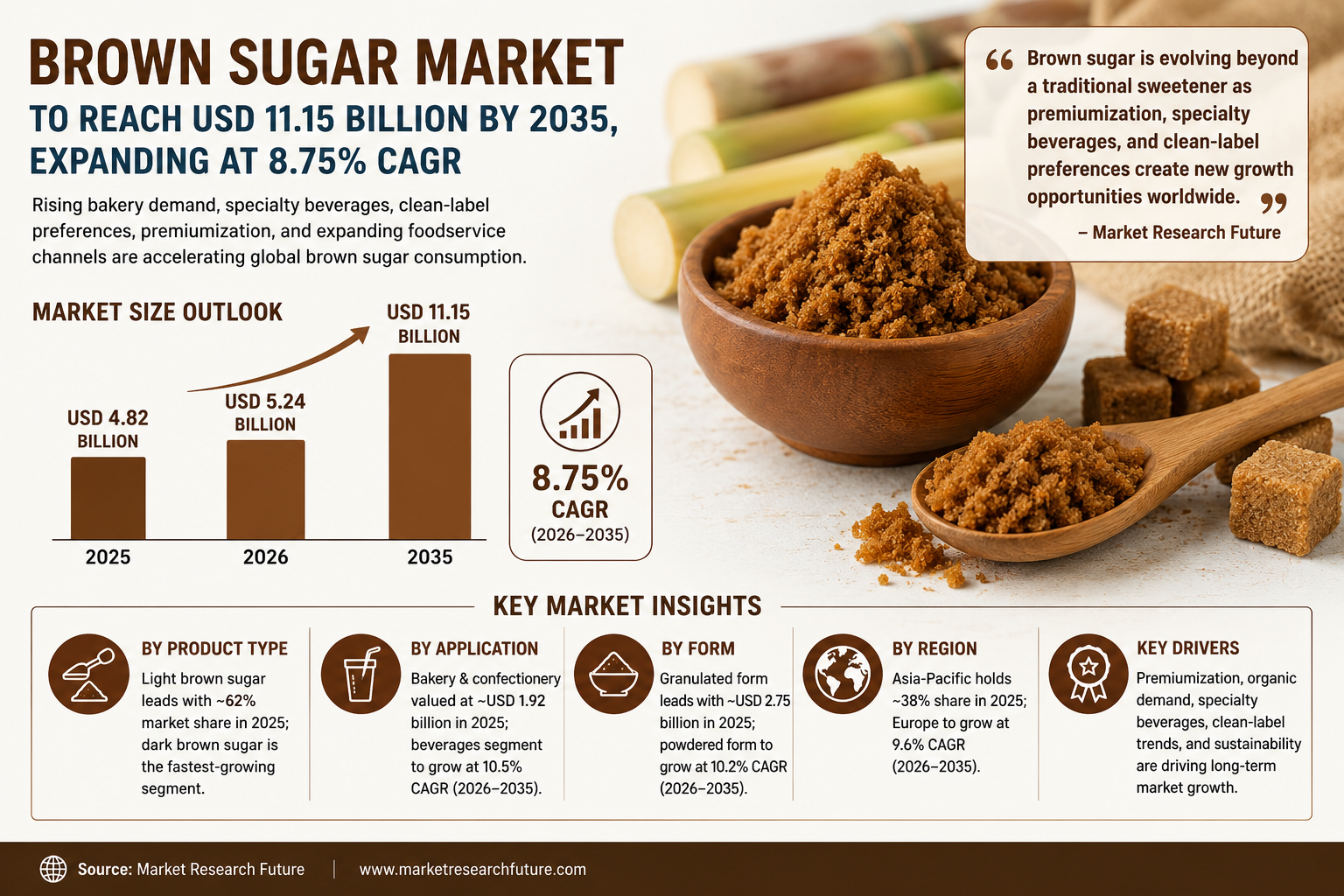
Rising bakery and confectionery demand, specialty beverages, clean-label trends, premiumization, & foodservice expansion are driving brown sugar market growth.
Brown sugar is evolving beyond a traditional sweetener as premiumization, specialty beverages, and clean-label preferences create new growth opportunities worldwide.”
NEW YORK, NY, UNITED STATES, August 21, 2026 /EINPresswire.com/ -- The global Brown Sugar Market is entering a sustained period of expansion, with the market estimated at USD 4.82 billion in 2025 and projected to increase from USD 5.24 billion in 2026 to USD 11.15 billion by 2035, registering a compound annual growth rate (CAGR) of 8.75% during the forecast period from 2026 to 2035, according to Market Research Future.— Market Research Future (MRFR)
The market's projected growth reflects changing consumer preferences, expanding bakery and confectionery production, increasing use of brown sugar in specialty beverages, premium and organic product development, and the continued evolution of foodservice and retail channels.
Brown sugar has traditionally been associated with baking, confectionery, sauces, desserts, and household cooking. Its role is now expanding across modern food and beverage applications as manufacturers and consumers increasingly seek recognizable ingredients, distinctive flavor profiles, and products positioned around authenticity and premium quality.
Unlike conventional white sugar, brown sugar contains molasses, giving it characteristic color, aroma, flavor, and moisture-retention properties. These functional and sensory characteristics make it valuable not only as a sweetener but also as an ingredient capable of contributing texture, color, caramelized notes, and moisture to finished products.
Market Expansion Driven by Diverse End-Use Applications
The global brown sugar industry is benefiting from the convergence of several long-term consumption trends. Bakery and confectionery remain among the largest application areas, while beverages are emerging as one of the fastest-growing channels.
Market Research Future identifies bakery and confectionery as a core application, with the segment valued at approximately USD 1.92 billion in 2025. Brown sugar's ability to contribute moisture and deeper flavor makes it attractive for cookies, cakes, pastries, desserts, sauces, glazes, and other products.
The beverage category is gaining momentum particularly quickly, with the market research pointing to a 10.5% CAGR from 2026 to 2035. Specialty coffee, bubble tea, flavored beverages, craft drinks, and other premium beverage formats are creating new opportunities for brown sugar in granulated, powdered, syrup, and liquid forms.
Foodservice and quick-service restaurants are also broadening the ingredient's visibility. Brown sugar is increasingly incorporated into beverage menus, toppings, desserts, marinades, and specialty recipes, allowing foodservice operators to differentiate products through recognizable flavor combinations and premium positioning.
Get Full PDF Sample Copy of Report: (Including Full TOC, List of Tables & Figures, Chart) @ https://www.marketresearchfuture.com/sample_request/25100
Consumer Preferences Support Brown Sugar Premiumization
Consumer perception is another important factor shaping the brown sugar market. Many consumers associate brown sugar with less-refined, traditional, natural, or artisanal food products. Although brown sugar and white sugar remain nutritionally similar in terms of their fundamental role as added sugars, the perception of brown sugar as a more traditional and flavorful ingredient has helped support demand across premium and natural-food categories.
The clean-label movement is further influencing purchasing decisions. Consumers are increasingly examining ingredient lists and seeking familiar ingredients that can be easily understood. Brown sugar's straightforward ingredient identity gives manufacturers an opportunity to formulate products around recognizable sweetening ingredients while developing distinctive flavor profiles.
Premiumization is particularly relevant to organic, Fair Trade, single-origin, artisanal, and specialty brown sugar products. Market Research Future notes that organic brown sugar can command a significant premium over conventional products, creating opportunities for producers and brands capable of establishing certification, traceability, provenance, and sustainability credentials.
This premium tier is expected to become increasingly important as retailers expand specialty grocery offerings and consumers demonstrate greater willingness to pay for differentiated products.
Light Brown Sugar Maintains Broad Market Reach
By product type, light brown sugar represents the dominant segment, accounting for approximately 62% of the market in 2025, according to the MRFR analysis.
Its broad adoption stems from its versatility. Light brown sugar offers a milder molasses profile and can be used across cookies, cakes, breakfast products, sauces, glazes, desserts, and household baking applications. Its adaptability makes it particularly attractive to both industrial food manufacturers and consumers.
At the same time, dark brown sugar is forecast to be one of the fastest-growing product categories, supported by its higher molasses content and stronger caramel and toffee characteristics.
The growth of specialty and craft baking is creating additional demand for dark brown sugar. Professional bakers, chefs, and consumers experimenting with premium recipes are increasingly using stronger-flavored sugar varieties to create differentiated sensory experiences.
Social media-driven food culture is also contributing to this trend by increasing consumer exposure to specialty baking recipes and visually distinctive desserts.
Powdered Brown Sugar Emerges as a High-Growth Format
By form, granulated brown sugar remains the largest and most established format. The segment was valued at approximately USD 2.75 billion in 2025, reflecting its widespread use across household, retail, foodservice, and industrial applications.
However, powdered brown sugar is projected to grow at a 10.2% CAGR from 2026 to 2035, making it one of the market's most dynamic formats.
The growth of powdered formats is closely connected to beverage innovation. Faster dissolution can make powdered brown sugar suitable for coffee, tea, specialty drinks, premixes, and other applications where processing efficiency and consistency are important.
Liquid brown sugar, syrups, compressed formats, and other specialty forms are also creating opportunities in hospitality, foodservice, beverage production, and premium consumer products.
As manufacturers continue to develop new formats, product innovation is expected to become a key competitive differentiator.
Asia-Pacific Remains the Largest Regional Market
Asia-Pacific accounted for approximately 38% of the global brown sugar market in 2025, making it the leading regional market. India and China together represent a substantial portion of regional consumption, supported by longstanding culinary traditions and established consumer familiarity with brown and traditional sugar products.
The region benefits from both traditional and modern consumption patterns.
China's traditional brown sugar culture contributes to demand outside conventional industrial food applications, while India's established consumption of jaggery and related cane-based sweeteners creates a natural pathway for brown sugar adoption. Japan also supports a premium segment through specialty products such as Okinawan kokuto.
Across Southeast Asia, expanding café culture, specialty beverages, foodservice, and modern retail are creating additional growth opportunities.
Rising disposable incomes and urbanization are expected to strengthen demand for packaged and premium food ingredients across emerging Asian economies throughout the forecast period.
Europe Expected to Deliver Strong Growth
Europe is projected to be one of the fastest-growing regional markets, with an estimated 9.6% CAGR from 2026 to 2035.
The region's growth is being supported by premiumization, organic food demand, specialty baking, ingredient transparency, and consumer interest in product provenance.
Countries including Germany, the United Kingdom, France, Italy, and the Nordic markets are contributing to the region's development. Industrial baking remains an important demand source, while artisan food culture and premium retail are expanding opportunities for differentiated brown sugar products.
European consumers are also increasingly attentive to sustainability credentials, creating opportunities for suppliers that can provide transparent sourcing, recognized certifications, and traceable supply chains.
North America Benefits From Retail and Foodservice Innovation
North America represented approximately 21% of global brown sugar revenue, with the United States serving as the region's primary market.
The U.S. market combines mature retail distribution with significant demand from commercial baking, foodservice, specialty coffee, and private-label products.
Private-label growth is reshaping the retail competitive environment as supermarkets and other retailers introduce brown sugar products designed to compete on price, packaging, and quality.
At the same time, premium brands are differentiating through organic certification, Fair Trade sourcing, specialty cane varieties, single-origin positioning, and sustainability claims.
The expansion of e-commerce is creating another route to market. Specialty and artisanal brown sugar producers can increasingly reach consumers without depending exclusively on traditional retail distribution networks.
Sustainability and Traceability Become Competitive Priorities
Sustainability is emerging as an increasingly important strategic consideration throughout the brown sugar supply chain.
Sugarcane cultivation and processing are closely connected to environmental factors including water use, agricultural practices, land management, energy consumption, and supply-chain emissions. As major food manufacturers strengthen sustainability commitments, brown sugar producers are under growing pressure to provide transparent sourcing and verifiable environmental credentials.
Certification programs and digital traceability technologies can help producers demonstrate the origin and sustainability attributes of sugarcane and finished products.
Market Research Future identifies traceability and sustainability certification as important opportunities for market participants seeking premium positioning and access to procurement programs that prioritize responsible sourcing.
The shift toward digitally documented supply chains could also improve transparency between growers, processors, distributors, retailers, and end consumers.
Technology Is Improving Processing and Product Consistency
Technological innovation is influencing brown sugar production as processors seek greater efficiency, consistency, and quality control.
Brown sugar's characteristics depend significantly on molasses content, crystal properties, moisture levels, and processing conditions. Variations in these parameters can affect color, texture, flavor, shelf stability, and application performance.
Advances in automated processing, analytical testing, and real-time quality monitoring are helping manufacturers improve consistency between production batches.
The adoption of advanced analytical technologies could become particularly important as premium and industrial customers demand tighter product specifications.
For producers competing in international markets, consistent quality can provide an important advantage when supplying multinational food manufacturers with standardized formulations.
Raw Material Volatility Remains a Key Challenge
Despite the positive growth outlook, the brown sugar market continues to face structural challenges.
Sugarcane prices can fluctuate significantly due to weather conditions, agricultural yields, energy markets, trade policies, and competition between sugar and ethanol production.
Climate variability represents a particularly important risk. Drought, excessive rainfall, temperature changes, and other agricultural disruptions can affect cane availability and production economics.
Market Research Future identifies raw sugarcane price volatility as a significant restraint on market growth. Competition from alternative sweeteners, including stevia, monk fruit, and allulose, also presents a challenge in consumer segments seeking reduced-calorie or sugar-free options.
Regulatory measures targeting sugar consumption may additionally influence demand in certain beverage and processed-food categories.
These pressures are likely to encourage manufacturers to focus on supply-chain resilience, long-term procurement relationships, processing efficiency, product differentiation, and premium market segments.
Opportunities Across Organic, Fair Trade, and Specialty Products
The market's expansion is creating significant opportunities beyond conventional brown sugar.
Organic and Fair Trade products can provide higher margins for producers able to meet certification and traceability requirements. Single-origin products can similarly leverage provenance and storytelling to differentiate from commodity offerings.
Specialty brown sugars derived from distinctive cane varieties or traditional production methods may attract consumers interested in authenticity and culinary experiences.
Food manufacturers are also exploring new applications. Brown sugar can be incorporated into sauces, marinades, dairy products, desserts, snacks, beverages, and other formulations where its flavor and functional characteristics provide value.
The combination of premiumization and application diversification is therefore expected to create multiple growth paths through 2035.
Competitive Landscape Remains Fragmented
The global brown sugar market is relatively fragmented, with no single company controlling more than 10% of worldwide revenue, according to the MRFR assessment. The top five companies collectively account for an estimated 28% to 34% of the market.
Major companies profiled in the market include Südzucker AG, Associated British Foods plc, Mitr Phol Sugar Corporation, Tereos, Nordzucker AG, Wilmar International, Thai Roong Ruang Group, Wholesome Sweeteners, Florida Crystals, and Lotus Sugar.
These companies compete through geographic reach, product portfolios, production capabilities, retail relationships, sustainability credentials, certifications, and specialty-product development.
The fragmented structure also leaves room for regional processors and niche brands to build market share through differentiated offerings and direct-to-consumer strategies.
Future Outlook: A More Premium, Diverse, and Transparent Market
The global brown sugar market is expected to evolve considerably over the next decade.
From a projected USD 5.24 billion in 2026, the market is forecast to reach USD 11.15 billion by 2035, representing an 8.75% CAGR during the forecast period.
The industry's future growth will likely be shaped by five interconnected forces: continued bakery and confectionery demand, specialty beverage innovation, consumer interest in recognizable ingredients, premium and organic product development, and sustainability-focused sourcing.
Asia-Pacific is expected to maintain its leadership position, while Europe offers strong premiumization opportunities and North America continues to benefit from sophisticated retail and foodservice channels.
At the product level, light brown sugar is expected to retain its broad market base, while dark brown sugar gains from specialty applications. Powdered formats are positioned for faster growth, particularly in beverages.
As food manufacturers and retailers increasingly look for differentiated ingredients, brown sugar is moving beyond its traditional role as a household baking staple toward a broader position within premium food, beverage, foodservice, and specialty ingredient markets.
With technological improvements supporting quality consistency and digital tools improving supply-chain visibility, market participants that combine reliable sourcing with product innovation, certification, and consumer-focused branding are likely to be well positioned to benefit from the industry's expansion through 2035.
About the Brown Sugar Market Report
The Brown Sugar Market study by Market Research Future covers the global industry across product types, forms, applications, and geographic regions for the 2021–2035 study period. The forecast period runs from 2026 to 2035, with a 2025 base-year market valuation of USD 4.82 billion and a projected 2035 valuation of USD 11.15 billion. The study identifies powder as the fastest-growing format, dark brown sugar as a high-growth product type, and beverages as a leading high-growth application.
The research methodology incorporates secondary research across regulatory databases, agricultural publications, food science journals, and food and agriculture organizations, complemented by primary research involving supply-side and demand-side industry stakeholders. Market estimation combines manufacturer revenue mapping, production-volume analysis, bottom-up calculations, and top-down validation.
Discover Related Research Reports By Market Research Future:
Organic Cane Sugar Market
https://www.marketresearchfuture.com/reports/organic-cane-sugar-market-26968
Date Sugar Market
https://www.marketresearchfuture.com/reports/date-sugar-market-27126
White Sugar Market
https://www.marketresearchfuture.com/reports/white-sugar-market-27825
Sagar Kadam
Market Research Future
+1 628-258-0071
email us here
Legal Disclaimer:
EIN Presswire provides this news content "as is" without warranty of any kind. We do not accept any responsibility or liability for the accuracy, content, images, videos, licenses, completeness, legality, or reliability of the information contained in this article. If you have any complaints or copyright issues related to this article, kindly contact the author above.
